The first time I took a taxi from Dubai Marina to Deira, I spent the whole ride watching the meter instead of the skyline. Not because anything was wrong — I just had no idea whether the number climbing on that little screen was normal, generous, or quietly ruining my week.
If you have ever had that feeling, this guide fixes it. Dubai taxi fares are metered, regulated and genuinely predictable once you know the three numbers that drive them. Below you will find how the meter works, a fare calculator you can use before you get in, worked examples for the routes people actually take, and the extra charges that surprise first-timers.
The short answer: how a Dubai taxi fare is calculated
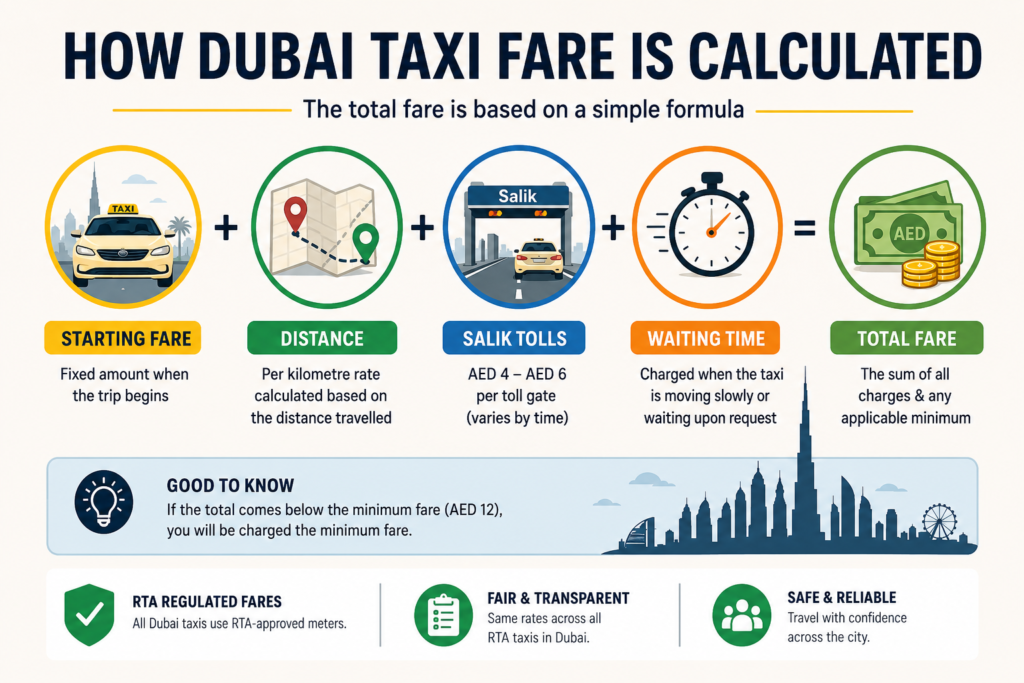
Every metered taxi fare in Dubai is built from the same simple sum:
Starting fare (flag fall) + (distance in km × per-kilometre rate) + Salik tolls + waiting time = your fare
There is also a minimum fare. If the sum above lands below it, you pay the minimum. That is why a two-minute hop across a single block costs more than the maths suggests.
So a rough estimate for most trips is: starting fare, plus about two dirhams per kilometre, plus four to six dirhams for each toll gate you pass under. Everything else in this guide is detail on top of that one line.
Dubai taxi rates at a glance
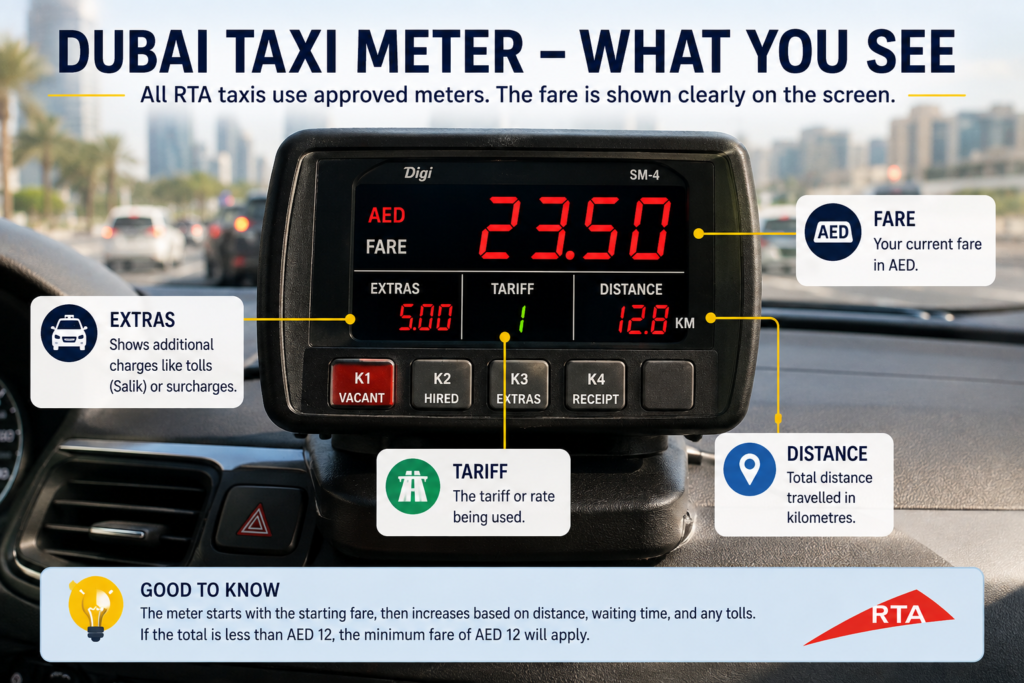
These are the standard RTA-regulated rates. Fares are reviewed periodically, so treat this as your baseline and trust the meter in front of you.
| Charge | Typical rate (AED) | When it applies |
|---|---|---|
| Starting fare — daytime | 5.00 | Street hail, 6:00 am to 10:00 pm |
| Starting fare — night | 5.50 | Street hail, 10:00 pm to 6:00 am |
| Starting fare — booked by app or phone | 6.00 | Any pre-booked pickup |
| Starting fare — airport rank | 25.00 | Taxis taken from the DXB or DWC arrivals rank |
| Per kilometre | 1.96 | Once the meter passes the initial distance |
| Minimum total fare | 12.00 | Any trip, however short |
| Salik toll gate | 4.00 – 6.00 | Each gate crossed; varies by time of day |
| Trip to another emirate | Surcharge applies | Added on top of the metered fare |
How the meter actually works
The starting fare
The moment your driver starts the trip, the meter opens at the flag fall. Flagging a car down on the street is the cheapest way in. Booking through an app adds a dirham or so for the convenience of not standing on a kerb in August. And a taxi taken from an airport rank starts far higher — more on why that is fair below.
The per-kilometre rate
After the initial distance covered by the flag fall, the meter ticks up per kilometre travelled. Just under two dirhams a kilometre is the number to carry in your head. It is why a 15-kilometre run across the city lands in the thirties rather than anywhere frightening.
The minimum fare
Short trips are where people feel overcharged, and it is almost always the minimum fare doing its work. Hop from one end of Downtown to the other and the meter might read eight dirhams — you will still pay twelve. That floor exists so drivers are not losing money on two-kilometre runs, and every metered taxi in the city applies it.
Waiting time
Traffic on Sheikh Zayed Road is charged. Once the car is crawling or stationary, the meter switches to a time-based rate rather than a distance one, which is why the same journey can cost noticeably more at 6:00 pm than at 11:00 am. If you are asking the driver to wait while you run into a shop, that is billed too.
Worked examples: what real Dubai trips cost
Estimates using the standard daytime rate, with light traffic and no surprises. Your meter will vary.
| Route | Approx. distance | Estimated fare |
|---|---|---|
| Dubai Marina → Mall of the Emirates | ~12 km | AED 30 – 40 |
| Downtown Dubai → Dubai Marina | ~22 km | AED 50 – 70 |
| DXB Terminal 3 → Downtown Dubai | ~13 km | AED 55 – 75 |
| DXB Terminal 1 → Dubai Marina / JBR | ~35 km | AED 100 – 130 |
| Deira → Business Bay | ~14 km | AED 35 – 50 |
| Dubai → Sharjah city centre | ~30 km | AED 80 – 120 |
| Dubai → Abu Dhabi | ~140 km | AED 250 – 320 |
Notice how much of the airport fare is the starting charge rather than the distance. A trip from DXB to Downtown is barely longer than Marina to Mall of the Emirates, but costs roughly twice as much.
Airport taxis: why they cost more
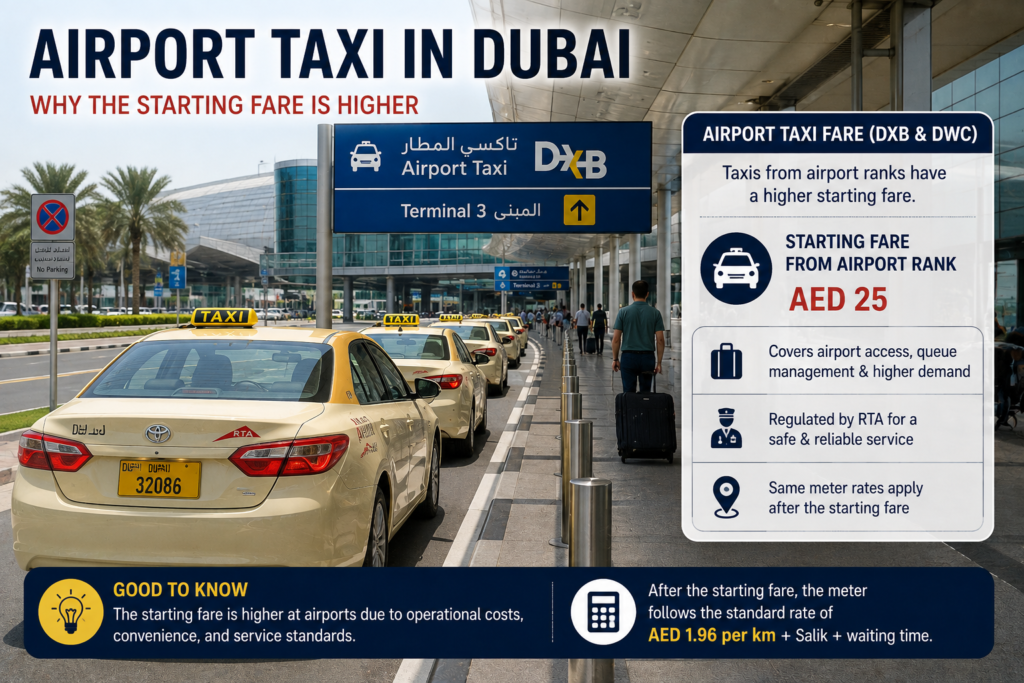
Taxis waiting at the DXB arrivals rank charge a much higher starting fare than a car you flag on the street. It is not a tourist tax. Those drivers queue in a holding area — often for a long stretch — for a single fare, and the higher flag fall compensates for the dead time.
If you would rather not pay it, you have options. The Dubai Metro Red Line runs directly from Terminals 1 and 3 and costs a few dirhams. Booking a car through a ride-hailing app for pickup at the departures level is usually cheaper than the arrivals rank. And if you are travelling light with time to spare, walking to a nearby hotel and hailing from there avoids the airport rate entirely.
For a family of four with luggage at midnight, though, the rank is worth every dirham. Walk out, get in, go.
Salik tolls: the charge people forget
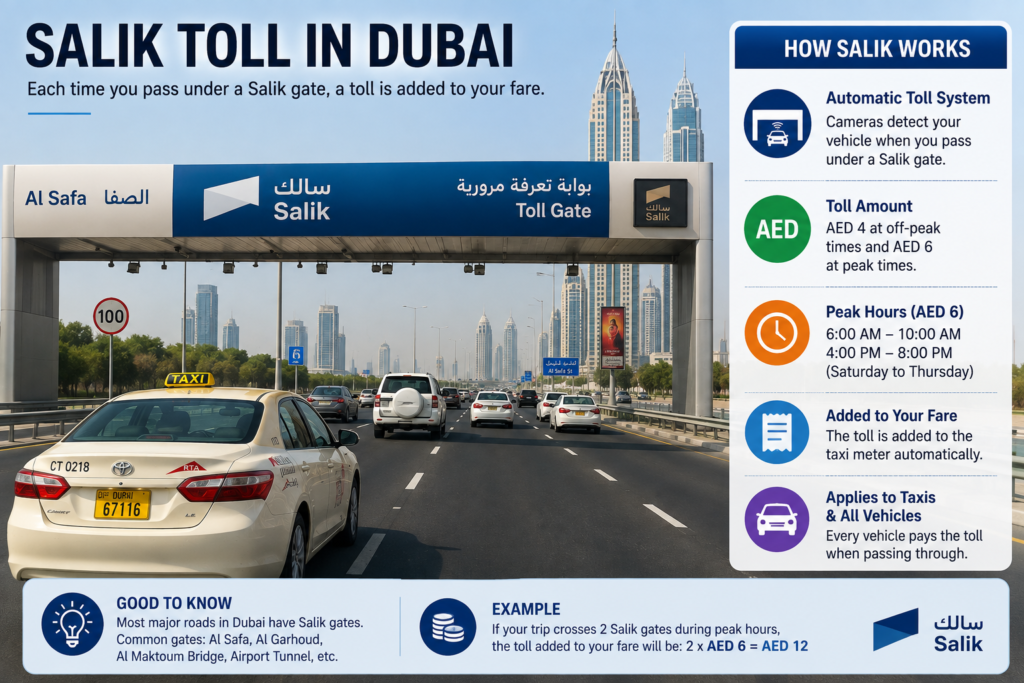
Salik is Dubai’s automatic road toll. There are no barriers and nothing to pay at the gate — an overhead reader logs the car and the charge lands on your fare at the end of the trip. Cross three gates and it is on your bill three times.
Two things worth knowing. First, tolls are no longer a single flat figure all day: charges are higher during peak periods and lower — in some windows, free — late at night. Second, a driver who takes a longer route to dodge a gate may or may not be doing you a favour, because the extra kilometres and minutes cost money too.
The gates sit on the routes you would expect: Sheikh Zayed Road at Al Barsha and Al Safa, Al Maktoum and Al Garhoud bridges, Airport Tunnel, Al Mamzar and Business Bay Crossing. Any trip crossing the Creek or running the length of Sheikh Zayed Road will pick up at least one.
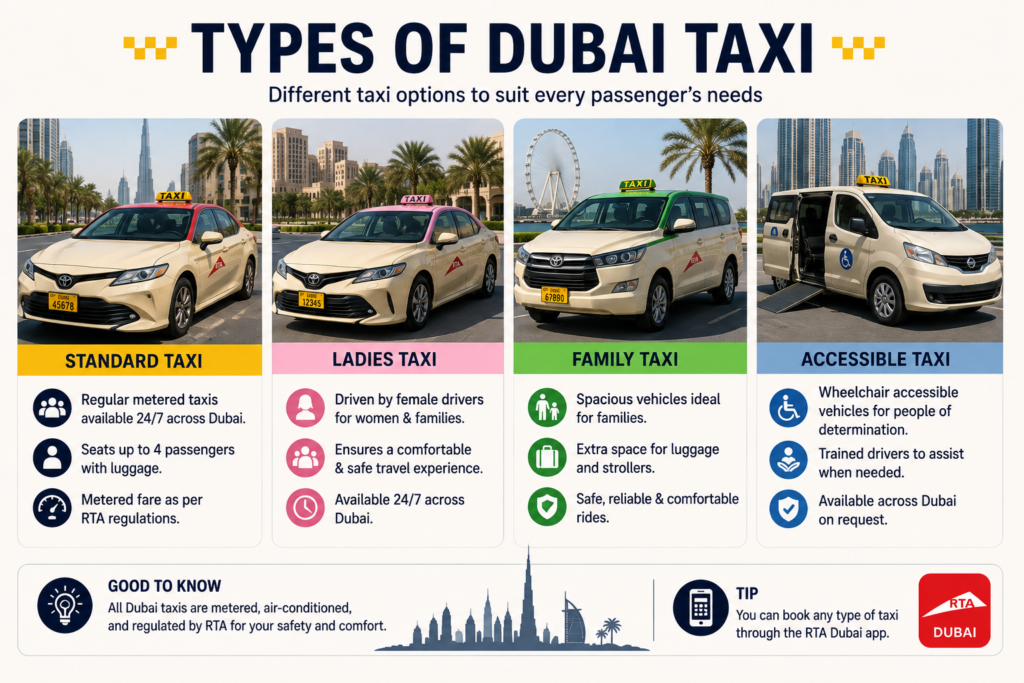
Types of Dubai taxi
- Standard taxi — the cream-coloured cars with coloured roofs, seating four. The roof colour identifies the operating company, not the price. Fares are identical across all of them.
- Ladies taxi — pink roof, women drivers, for women and families. Same meter, same rates.
- Family taxi — a van seating up to seven, useful for groups or a boot full of luggage. Slightly higher rates.
- Accessible taxi — wheelchair-equipped vehicles, bookable in advance through the RTA.
- Luxury and limousine — premium vehicles booked through hotels or apps, priced by quote rather than by meter.
Taxi, ride-hailing app, or Metro?
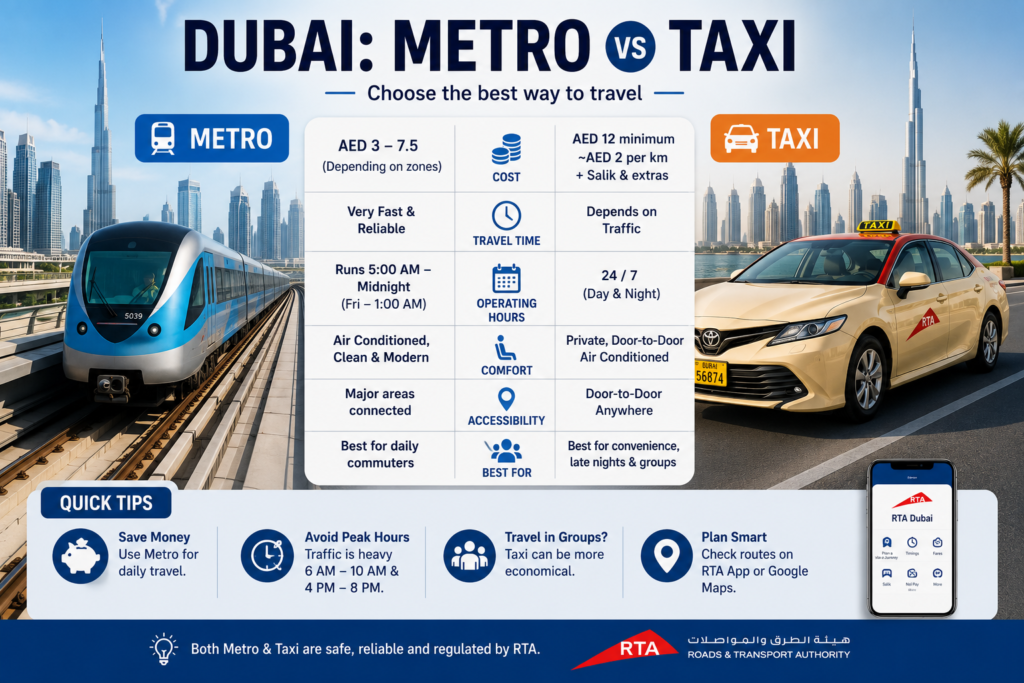
The honest comparison, having used all three:
Metro wins on price and beats everything on Sheikh Zayed Road at rush hour, when the train is moving and the traffic is not. It loses the moment your destination is more than a short walk from a station — which, in a city built for cars, is often.
Street taxis are the cheapest door-to-door option because they use the lowest flag fall. In busy districts you rarely wait more than a few minutes.
Ride-hailing apps cost more but buy certainty: a fixed price before you commit, a named driver, and a car that comes to you. In residential areas where taxis are thin on the ground, or at 2:00 am, that is worth paying for. During surge pricing, the gap can widen sharply — check the fare before confirming.
Seven ways to keep the fare down
- Walk to a main road before hailing. Two minutes on foot can save the airport or booking premium.
- Travel outside peak hours. The same route costs measurably less when the meter is counting kilometres instead of minutes stuck in traffic.
- Know your destination’s landmark. “The tower next to the mall” costs money in wrong turns. Building name and nearest junction is enough.
- Confirm the meter is running as you set off. It should be, always — a metered fare protects you as much as the driver.
- Take the Metro for the long leg, then a taxi for the last few kilometres. On cross-city journeys this is often the cheapest combination by a wide margin.
- Split with others. Four people in one taxi frequently beats four Metro tickets, and arrives closer to the door.
- Keep the receipt. It carries the taxi number, which is what you need if anything is left behind.
Paying, and tipping
Card payment is accepted in Dubai taxis, and contactless is normal. Cash still works and small notes are appreciated — handing over a 500 for a 30-dirham fare is a good way to start a conversation neither of you wanted.
Tipping is not expected. Most residents round up to the nearest five or ten dirhams and leave it there. For a driver who helped with heavy luggage or waited patiently, a little more is a kind gesture rather than an obligation.
If something goes wrong
Dubai taxis are regulated by the RTA, and the system works if you use it. Every trip generates a record tied to the taxi number printed on your receipt, which is why keeping it matters.
Left your phone on the back seat? Report it through the RTA’s lost-and-found service with the taxi number and trip time. Overcharged, or the meter was not running? The same channel handles fare complaints. The RTA call centre operates around the clock on 800 9090, and the RTA Dubai app handles bookings, complaints and lost items in one place.
Dubai taxi fare calculator
Enter your trip details for an instant estimate. This is a guide, not a quote — the meter in the car is always the final word.
Frequently asked questions
How much is a taxi from Dubai Airport to Downtown Dubai?
Budget roughly AED 55 to 75 from a DXB terminal to Downtown. Most of that is the higher airport starting fare rather than the distance, which is only around 13 km.
What is the minimum taxi fare in Dubai?
AED 12. If your metered fare comes in below that, you pay the minimum — which is why very short trips feel expensive relative to the distance.
Are Dubai taxis metered, or do you negotiate?
Metered, always, for standard RTA taxis. The meter should be running from the moment you set off. Limousine and luxury services are the exception — those are quoted upfront.
Can I pay for a Dubai taxi by card?
Yes. Card and contactless payment are accepted in RTA taxis. Carrying some cash in small notes is still handy.
Do Dubai taxis charge more at night?
Slightly. The starting fare is higher between 10:00 pm and 6:00 am, but the per-kilometre rate does not change. In practice, late-night trips often work out cheaper overall because the roads are clear and you are not paying for waiting time.
What is Salik and do I pay it in a taxi?
Salik is Dubai’s automatic road toll. There is nothing to pay at the gate — each crossing is added to your fare at the end of the trip.
Can I take a Dubai taxi to Abu Dhabi or Sharjah?
Yes. Inter-emirate trips are metered with a surcharge added. Dubai to Abu Dhabi typically runs AED 250 to 320. Agree that the driver is willing to make the trip before you set off.
Is a taxi or the Metro cheaper in Dubai?
The Metro, by a wide margin, and it is faster on congested corridors at peak times. Taxis win when your destination is not near a station, when you have luggage, or when you are travelling in a group.
How do I report a problem or find something I left in a taxi?
Call the RTA on 800 9090 or use the RTA Dubai app. Have the taxi number from your receipt and the approximate trip time ready.
The bottom line
Dubai taxi fares are one of the more transparent things about getting around the city. Learn three numbers — the starting fare, roughly two dirhams a kilometre, and a twelve-dirham floor — and you can estimate almost any trip before the car pulls away. Add a few dirhams per toll gate, allow for traffic, and your guess will land close.
The rest is choosing well: the Metro when the roads are jammed, a street hail when you want the cheapest fare, and the airport rank when you have three suitcases and no patience left. All three are the right answer sometimes.
Fares are set by Dubai’s Roads and Transport Authority and are reviewed periodically. Figures here were accurate at the time of writing — check rta.ae for the current rates before relying on them.